2.4.2 Fault Dip Calculation

The Fault Dip, is calculated in the Faults and Fractures 3D Control Center, under Tools. It generates a ratio cube of the vertical displacement per horizontal distance. The cube has two components - Inline Dip and Crossline Dip. In a time survey, the values are in microseconds/meter and in a depth survey (with meter as unit), the values are in millimeter/meter. The Fault Dip unit is the same as the unit used in Steering cubes, created using the Dip Steering plugin.
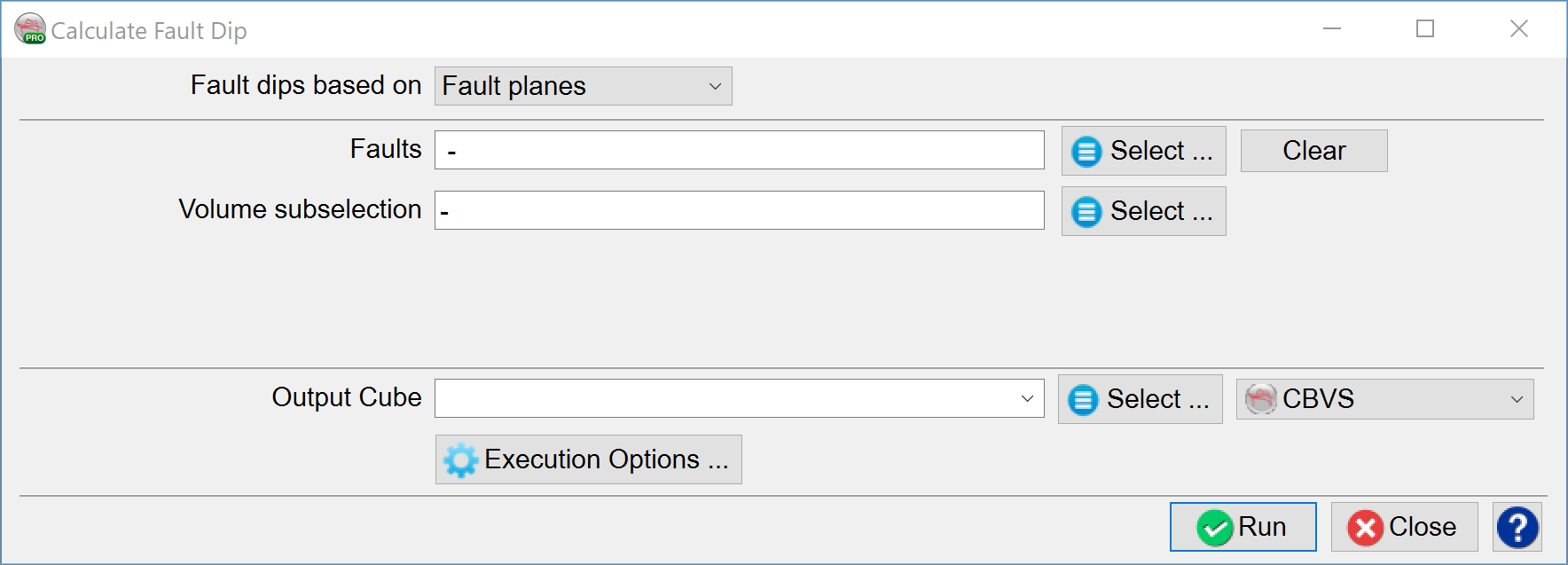
Once the dip cube has been calculated (either using the Fault Dip Calculation or Dip Steering), the user can read the values from the Manage Seismic window using the Browse tool.
In OpendTect 6.6, the user can manually measure the dip of the line joining any points in either degrees or microseconds/meter, with the Measure tool in the Graphics Toolbar. The user can use this as a QC tool. The dip angle is measured from the horizontal and is usually lower than the angle 'visible' on screen as the Z-axis is usually stretched in comparison to the horizontal. Therefore it may be that what appears to be steeply dipping on screen has only a moderate dip. If you increase the velocity, it will increase the calculated vertical distance and the dip, and vice-versa.