5.2.1.3.2.2 Continuous Events
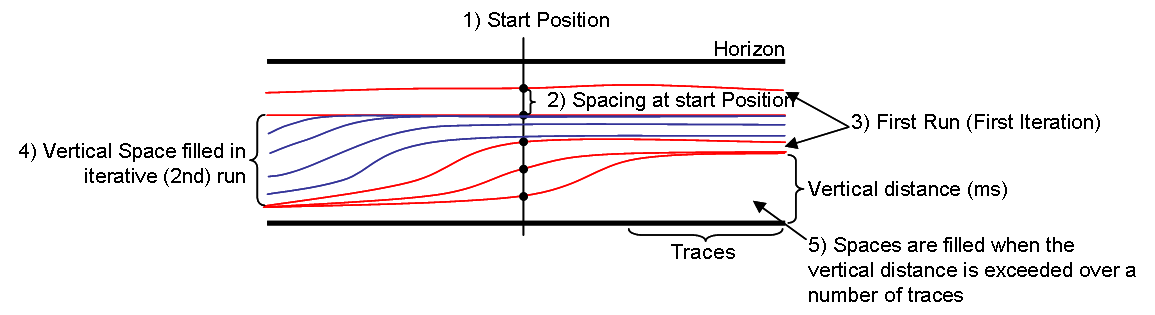
At the start position (1) numerous horizons are initiated at a user defined interval (2). Normally, the sample rate is used here in order to initiate a horizon at every sample. These horizons are tracked from the start position outward within the whole extend of the survey (3). When the horizons diverge large vertical spaces between the horizons are created, which are filled in iterative runs (4). To prevent very small vertical spaces to be filled (with horizons that are present in the whole survey) the spaces are defined by a vertical setting as well as a horizontal (5). A vertical space is filled when the vertical distance between the horizons exceeds a user specified amount over a lateral extend -the user defined number of traces-.
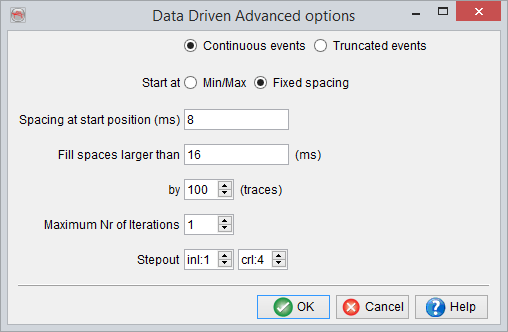
Start at: The (Start at) radio box (for Continuous HorizonCube) is used to define the trace position from which the horizons will be tracked. By default, Fixed spacing is used and the corresponding constant value is filled in the Spacing at start position field. The Min/Max relates to a given seismic cube (positive / negative amplitudes) i.e. the HorizonCube events will be initiated at a start position defined by the Min/Max amplitudes and this will not yield an evenly spaced HorizonCube at start position.
Fill spaces larger than (ms) or by (traces): This is used to specify the minimum allowed gap vertical (in ms / m / ft) or by distance (m / ft) to be filled in the subsequent defined iterations.
Max. Nr. of iterations Depending on the geologic thickness variations within a defined package, often the gaps are found after the first iteration of a HorizonCube. To fill the gaps in a HorizonCube the initial iteration value should be defined (either 1 or 2). The best practice is to create a HorizonCube with 1 iteration initially and then at later stages the gaps could be filled using the HorizonCube tools (Add more iterations). This is suggested as a quality control step because the HorizonCube calculation is slower for subsequent iterations. For instance, the HorizonCube with 1 iterations and smaller step outs could be generated in 1 or two hours. However, if the iterations are 2, the HorizonCube calculation time exponentially increases.