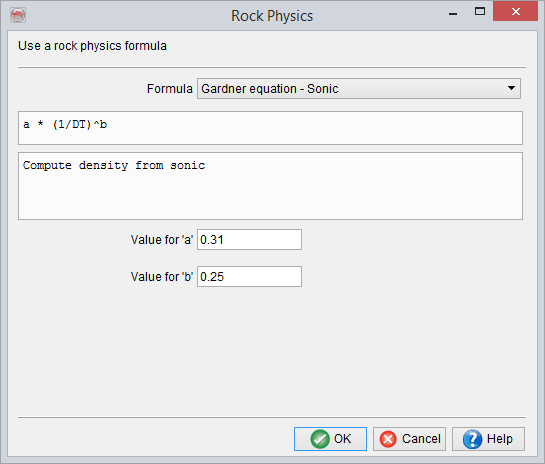
8.3.2.3 Math-based Layer Properties
Mathematics equations can be set to derive pseudowell properties from other modeled properties, or using simple rock property models. For instance, this first example computes the P-wave velocity value in each layer from the modeled density.
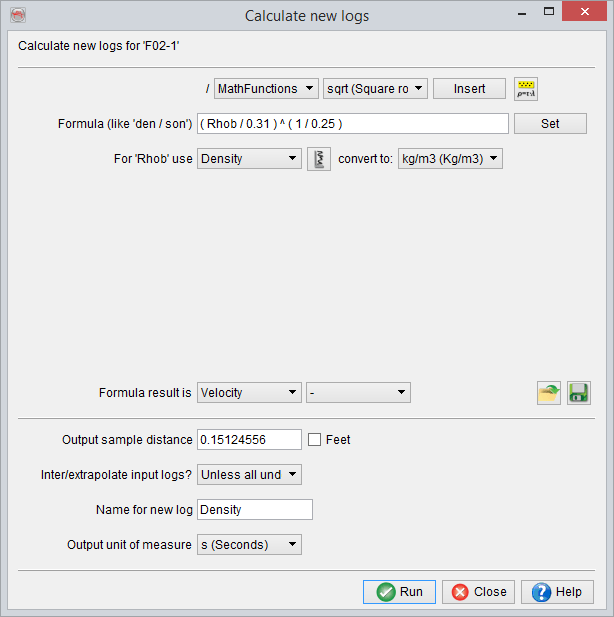
Input properties are converted to the selected unit of measure before the equation is computed. The Formula output unit have to be specified, since it might be different than the default property unit of measure. Example: The formula delivers a result in g/cm3, but the preferred display unit is set to kg/m3 (in the layer properties manager for the selected property).
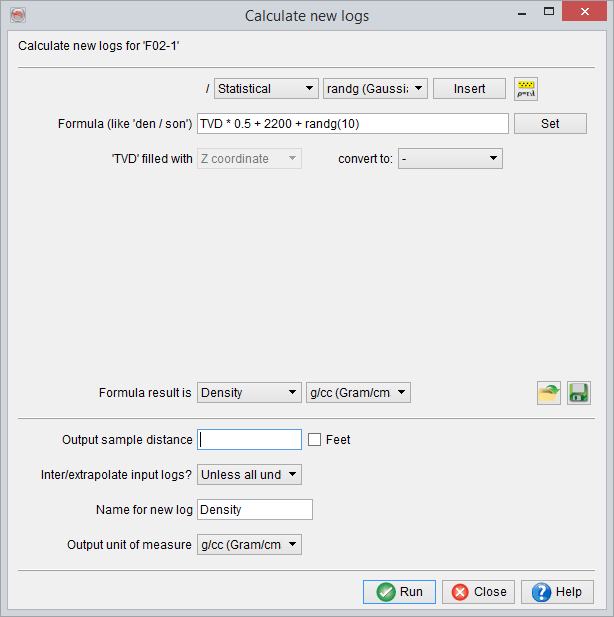
Layer features like thickness and the depth at the top of the block can be used in the mathematical equation as input. Note that thickness is available from the drop-down property selection menu. While TVD (Depth) is available through the Insert option of type 'Other'.
The second example creates a vertical velocity gradient starting from 2200 m/s at zero depth with a slope of 0.5 (m/s)/m and added Gaussian noise with a standard deviation of 10 m/s.
User-defined formula can be saved ( ) and retrieved (
 ).
).
The same syntax as in the mathematics attributes should be used.
Rock physics link
The rock physics library, via  , provides a comprehensive set of equations that can be used to derive logs from others. Please refer to the OpendTect User Documentation.