11.12 Instantaneous
Name
Instantaneous -- Attribute that returns a value at a single sample location.
Description
Instantaneous attributes are computed sample by sample, and represent instantaneous variations of various parameters. Instantaneous values of attributes such as trace envelope, its derivatives, frequency and phase may be determined from complex traces. (see figure below)
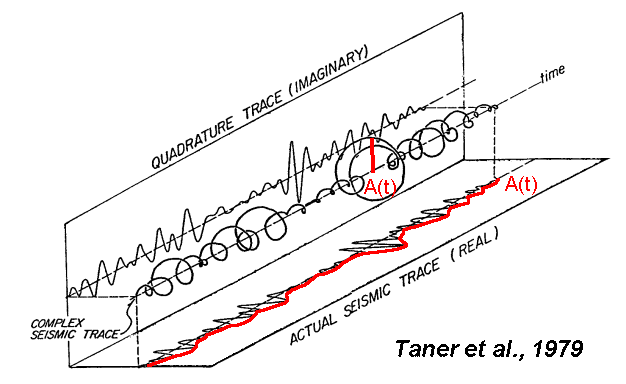
Complex Seismic Trace Attributes (From Taner et al.,)
The imaginary part of the complex trace is computed via the Hilbert transform. Possible outputs are:
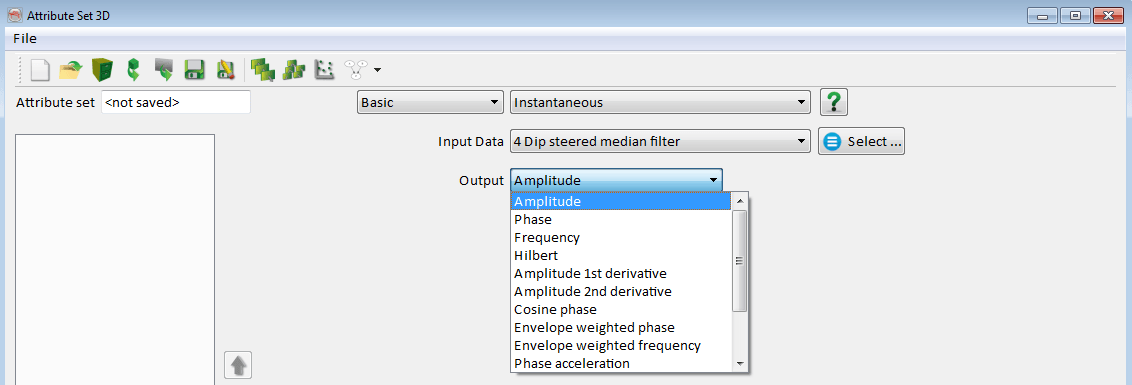
Instantaneous Amplitude (Trace Envelope)
Outputs the instantaneous amplitude (or envelope) of the selected data volume at the sample location.
It can be used as an effective discriminator for the following characteristics:
- Mainly represents the acoustic impedance contrast, hence reflectivity,
- Bright spots, possible gas accumulation,
- Sequence boundaries,
- Thin-bed tunning effects,
- Major changes in depositional environment,
- Spatial correlation to porosity and other lithologic variations,
- Indicates the group, rather than phase component of the seismic wave propagation.
- Amplitude 1st derivative: Time derivative of the instantaneous amplitude i.e time rate of change of the envelope. It shows the variation of the energy of the reflected events. It is used to detect sharp interfaces and discontinuities.
- Amplitude 2nd derivative: Second derivative of the envelope. It provides a measure of the sharpness of amplitude peak. It can be used to identify all reflecting interfaces within the seismic bandwidth.
Instantaneous Phase
Calculates the instantaneous phase at the sample location, it emphasizes spatial continuity/discontinuity of reflections by providing a way for weak and strong events to appear with equal strength.
This attribute is of central importance since it describes the location of events in the seismic trace and leads to the computation of other instantaneous quantities.
The instantaneous phase makes strong events clearer and is effective at highlighting discontinuities of reflectors, faults, pinch-outs, angularities and bed interfaces. Seismic sequence boundaries, sedimentary layer patterns and regions of onlap/offlap patterns often exhibit extra clarity
The instantaneous phase relates to the phase component of wave-propagation, it is also used to compute the phase velocity.
- Cosine phase: Cosine of the instantaneous phase, also called normalized amplitude. It has the same uses as instantaneous phase with one additional benefit: It is continually smooth. By providing the +/-180 degree discontinuity that occurs with instantaneous phase, the cosine of instantaneous phase can be further processed (e.g, filtered and stacked) using conventional seismic processing tools. Amplitude peaks and troughs retain their position, but with strong and weak events now exhibiting equal strength
- Envelope weighted phase: Instantaneous phase, weighted by the envelope over the given time window
- Rotate Phase: Phase output is rotated through a user-specified angle
Instantaneous Frequency
Outputs the instantaneous frequency at the sample location.
The instantaneous frequency attribute responds to both wave propagation effects and depositional characteristics, hence it is a physical attribute and can be used as an effective discriminator.
It uses include:
- Hydrocarbon indicator by low frequency anomaly.
- Fracture zone indicator, since fractures may appear as lower frequency zones.
Bed thickness indicator. Higher frequencies indicate sharp interfaces such as exhibited by thinly laminated shales, lower frequencies are indicative of more massive bedding geometries, e.g. sand-prone lithologies.
- Envelope weighted frequency: Instantaneous frequency, weighted by the envelope over the given time window
- Phase acceleration: Time derivative of the instantaneous frequency
- Thin bed indicator: Difference between instantaneous frequency and Envelope weighted frequency
- Bandwidth: The absolute value of the envelope time derivative
- Q factor: Instantaneous frequency divided by the bandwidth
Hilbert (Quadrature Amplitude)
The quadrature trace is the imaginary part of the complex seismic trace (see image above), and can be computed from the real trace via the Hilbert transform.
Both the real trace and its quadrature counterpart share the same amplitude spectrum; the quadrature however is phase rotated by 90 degrees. Zero-crossings on the real trace transform to peaks and troughs on the quadrature trace and peaks and troughs on the real trace transform to zero-crossings on the quadrature trace.
The quadrature is used in various mathematical combinations to compute other complex trace attributes such as instantaneous phase and instantaneous frequency. it is sensitive to energy, frequency, and phase.