4.3.6.3 Geometry 2D
This window is used to import 2D interpretations form ascii files. Select the input ascii file. You may display the input file by pressing the Examine button. The input file should be column sorted with one point per record (line).
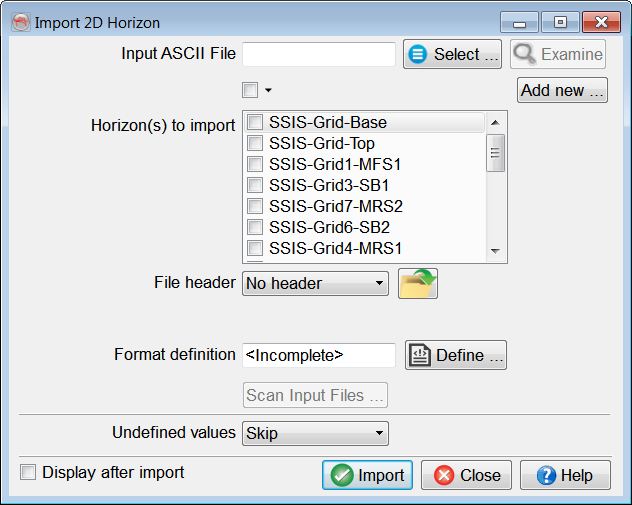
Several 2D horizons can be imported at once. Their name should be provided in front of Select Horizons to import. This can be done by pressing Add new right of it, and providing each time a new horizon name. This will populate the list of importable horizons. Only the highlighted horizons will be imported, which is why each new horizon is highlighted after providing its name. Ctrl-left click may be used to highlight or deselect an horizon.
Next, the presence of a file header must be specified and the file format definition must be provided. The header, if present, can be of fixed length (number of lines), or delimited on its last line by a keyword.
Predefined and saved file formats are available by pressing the  icon. Otherwise the format must be manually specified. The Define button gives access to the format definition window.
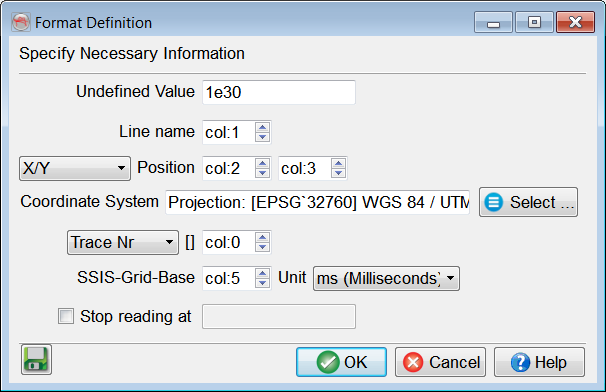
You must specify in the format definition window the line name, column numbers for the position, in terms of an X-Y pair or a unique trace number, and the horizon(s) column(s). Horizon Z values that should not be read must all have the same numerical value, which is to be filled in as the Undefined value. Reading may be stopped at a specific line by providing the adequate keyword.
If Coordinate Reference System (CRS) is defined for the survey, CRS conversion will be available in the import window.
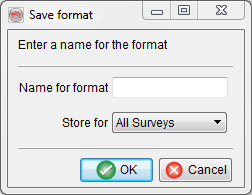
It is recommended to save the format definition for a later use and QC, by clicking the  icon . In pop-up window, write the name of the format and store it. The format can be stored at different levels (All surveys, Current survey, Current OpendTect user level) depending on the usage. Press OK when done.
It is highly recommended to scan the input file after providing its format, and prior to the actual import. The scanned information will pop-up and error(s) or warning(s) may suggest a change of the format definition. Press Go to launch the import.